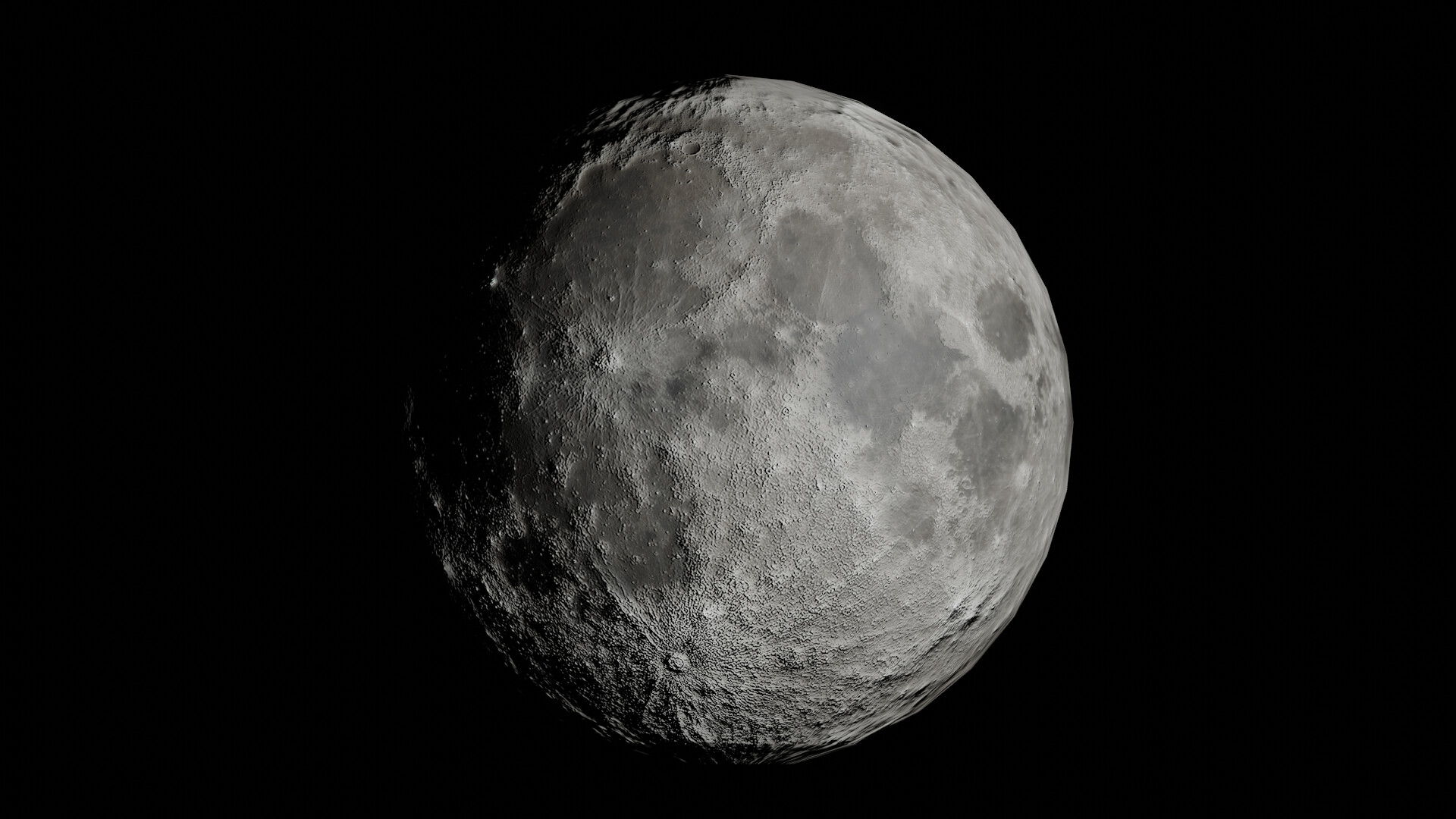
Moon 3D Model
The Moon is Earth's natural satellite, the only satellite that Earth has. The Moon is also the fifth largest satellite in the Solar System. The Moon orbits Earth at a distance of about 385,000 kilometers and takes about 27.3 days for one orbit.
More details:
Natural Satellites:
The Moon is a celestial body that orbits Earth naturally, not man-made.
Size:
The Moon is relatively large compared to Earth, with a diameter of about 3476 km, about a quarter of the Earth's diameter.
Phases:
The Moon has different phases, namely new moon, first quarter, full moon, and last quarter.
Light:
The Moon does not produce its own light, but reflects sunlight.
Origin:
The Moon is thought to have formed from the remains of a large collision between Earth and an object the size of Mars about 4.5 billion years ago.
Other characteristics:
The Moon has a solid, rocky surface, and holes due to asteroid impacts. The Moon has a very thin atmosphere. The Moon has no rings or natural satellites.
Distance:
The average distance between Earth and the Moon is about 384,400 kilometers.